March and the Middle Level: a boat owner's guide
March is a practical Fenland base for a boat that values open water, generous skies and a route that changes character from drainage channel to connected navigation. The Middle Level Navigations are not a conventional leisure canal: they are an engineered network, administered in important parts by the Environment Agency, where water-level management and land drainage remain fundamental. Plan the whole passage rather than treating March as an isolated destination. Check current notices, closures, dimensions and permission requirements before casting off, because a route that looks simple on a map may involve a lock, a control structure or a tidal approach.
March Cut and the town reach
The navigable March Cut leads through the town and gives March its clearest boating identity. Its straight, engineered alignment reflects Fenland drainage rather than a contour canal, so the view is wide and the banks can feel exposed. Approach landings slowly and keep wash down near moored craft and banks. March is also a useful place to pause before committing to a longer Middle Level journey: inspect lines, fenders, bilge arrangements and charts while still in a familiar, sheltered setting. Do not assume every nearby drain or backwater is open to navigation.
A network, not a single canal
From March, the Middle Level system connects toward routes including the Nene and Great Ouse, but the connections are operationally different. The level was designed to move and control water as well as boats. That matters to skippers: gates, sluices and pumping arrangements can affect passage, and an apparently navigable watercourse may be restricted or non-navigable. Use the navigation authority’s current information and carry a proper Fenland chart. Treat published dimensions as a planning guide, not a substitute for checking water levels on the day.
Locks, levels and disciplined preparation
Middle Level passages reward methodical crews. Allow time to prepare lines before entering a lock, keep crew clear of moving gates and do not rely on a centre line alone. A boat’s air draught, beam and draught should be compared with current published limits, especially where a route leads onward through connecting navigation. Strong wind can make a broad level awkward even without river current. A well-fitted cockpit or cratch cover is useful between manoeuvres, but it should be quick to remove and secure safely before lock work.
Where drainage comes first
The surrounding drains carry the practical history of the Fens: banks protect low-lying farmland and water levels are managed for that wider purpose. Boaters should therefore read warning boards and respect maintenance activity, rather than interpreting every channel as a cruising invitation. Avoid creating wash alongside vulnerable banks. Keep rubbish, ropes and fenders aboard, and report damaged signs or obstructions through the authority’s established channel. The quiet landscape is a working one, not a marina-style environment with facilities at every stopping point.
Weather across the open fen
March’s exposed setting magnifies a south-westerly wind. A forecast that seems mild inland can still make an open reach uncomfortable, particularly for a high-sided narrowboat or cruiser. Rain can reduce visibility and make steelwork slippery; bright weather brings glare and UV exposure across the water. Ventilation under a cover remains important in damp conditions, while tensioned fittings should be checked after gusts. Keep an eye on the bank, not just the compass: a steady course and low wash protect both navigation and the drainage edge.
A sensible day around March
A short local outing can be more informative than a rushed long passage. Use it to establish how the boat handles the straight reaches, where crew prefer to stand and how quickly a cover can be stowed. March town provides a recognisable point for provisions and a walk, but do not turn that into an assumption about permanent mooring availability. Moor only where permitted, observe time limits and leave access clear. In the evening, inspect seams and fastenings; Fenland wind finds loose hardware quickly.
Connecting onward with care
Journeys toward the Great Ouse or Nene require a route-specific plan, not simply a larger fuel tank. Confirm the exact connecting route, operating arrangements and any booking or key requirements with the relevant authority. The tidal character of downstream approaches can be decisive, and a delayed lock passage may change the day’s safe window. Keep paper notes as well as a phone, and tell someone ashore the intended route. Middle Level navigation is rewarding precisely because it asks owners to be active waterway managers.
Covers for an exposed working landscape
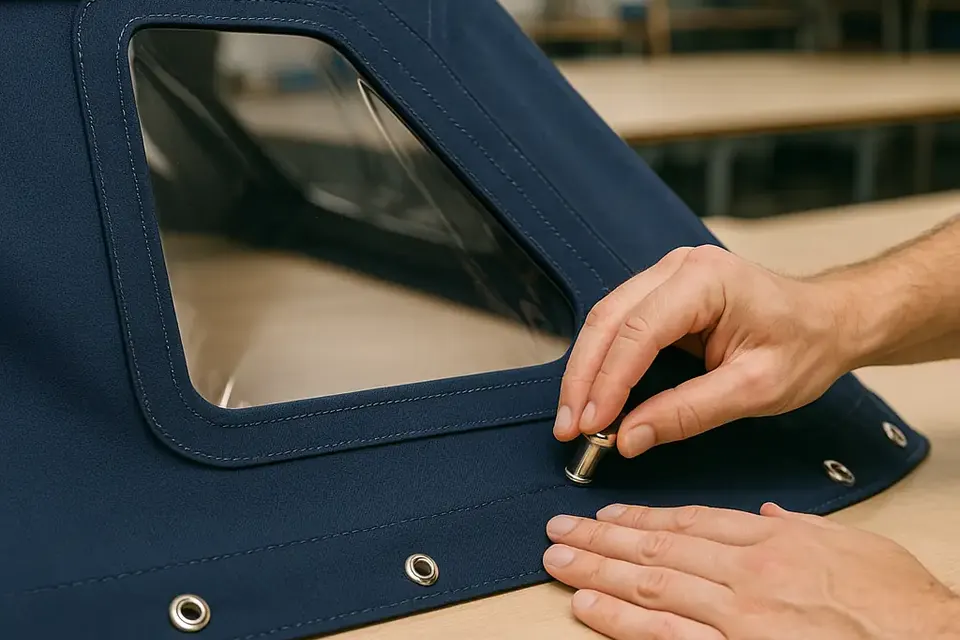
On a March mooring, cover choice should follow how the boat is used. A tonneau can keep a cockpit dry while retaining quick access; a cratch cover protects the forward well; a pram-style canopy can make stern work more tolerable in rain. Breathable marine fabric helps limit condensation, but no cover removes the need to air the boat. Measure around rails, hinges, screens and tiller arrangements. A replacement copied from an existing cover can preserve useful fastening positions without pretending that two boats are identical.
Respecting March’s character
March offers a good lesson in Fenland boating: beauty and utility occupy the same bank. The route is calm-looking but technically purposeful, and the most considerate skipper leaves little trace. Check notices immediately before departure, allow for wind and delays, and never force a passage at a structure that is closed or outside its operating arrangements. With those habits, the town becomes more than a stopping point: it is a sound starting line for exploring the Middle Level’s engineered waterways and their links across eastern England.
For March departures, keep the Middle Level noticeboard and a Fenland chart together; the route rewards a crew that plans around the working waterway.
Owners comparing a new canopy can start with our boat cover services, then review marine fabrics and the postal copy service.